
Religion, Philosophy & Ethics
Religion, Philosophy and Ethics (Eduqas)
Religion, Philosophy and Ethics gives you a fascinating challenge: the challenge of debating philosophical and ethical questions which might have no answer, such as ‘does God exist?’ and ‘how should we behave?’
“I know that I am wise because I know that I know nothing.” (Socrates 464 BC)
The course is split into three areas which interlink; you will be looking at significant Christian practices and beliefs that shape religious identity, as well as considering ultimate philosophical questions and learning about different ethical theories.
Course Content & Assessment
Component 1 (33.3%) – Philosophy of Religion
In this module you will learn about arguments for the existence of God, challenges to religious beliefs such as the problem of evil in the world, and the variety and validity of religious experience.
You will study how the philosophy of religion has influenced religious language.
You will also study the relationship between psychology and religion, learning about Freud and Jung – is belief in God innate or just a product of our mind?
Component 2 (33.3%) – Religion and Ethics
In this module you will learn about ethical language and thinking. You will be introduced to different ethical theories, such as Utilitarianism, Situation ethics and Natural Law.
You will learn how to apply the ethical theories you learn about to a range of moral issues, such as homosexuality and nuclear weapons.
You will also learn about free will and determinism – do we really have free will?
Component 3 (33.3%) – Study of Christianity
In this module you will learn about religious figures and sacred texts (such as the different narratives of Jesus’s birth), social and historical developments in Christianity and religious concepts such as atonement and the Trinity.
You will also study Christian practices such as baptism, the Eucharist and festivals.
You will also look at modern day developments and the relationship between religion and society.
Each module is an externally assessed 2 hour exam consisting of AO1 (knowledge and understanding) and AO2 (evaluation) essay questions.
Teaching
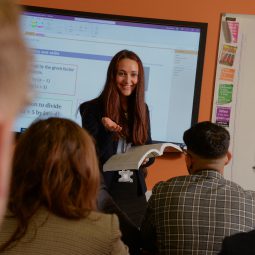
You will be taught by two teachers for this subject. The classes will involve a range of different teaching approaches. You will be asked to take part in whole group and small group discussions, as well as individual tasks. You will be able to research areas of the course and present your research to the class for discussion. RS is an academic subject; you will be given further reading to extend your understanding and you will be challenged in your thinking, justification, and essay writing skills. Each lesson, subject knowledge will be presented in an organised and engaging way which will help you in your learning and skill development.
Your Future
Many universities offer courses which are compatible with this A Level, including Religious Studies, Theology and Philosophy. However, the broad nature of this course means it will link well with many other disciplines, in particular sociology, psychology, law and medicine. Some graduates will go on to directly related careers such as teaching or ministry work, however, many will work in related fields such as medicine, law, social work, education, journalism or human resources management.







The Blue Coat Sixth Form is proud to be part of the Cranmer Education Trust
Cranmer Education Trust is a company limited by guarantee and an exempt charity registered in England. Company registration number: 07687709. Registered Office: Cranmer Education Trust, c/o The Blue Coat School, Egerton Street, Oldham OL1 3SQ. The website address is www.cranmereducationtrust.com and the phone number 0161 785 5082.